The Greatest Fear in Old Age is Angina Pectoris – Poor Prevention Can Be Fatal, Early Health Maintenance is Crucial, Rubbing the Ximen Acupoint Shows Efficacy
A few minutes each day leads to a century of health.
Hello everyone! I am Old Hu of Traditional Chinese Medicine.
In ancient China, there is a remarkable book called the Huangdi Neijing, which states: "The meridians and collaterals determine life and death, treat all diseases, regulate excess and deficiency, and must not be obstructed."
Acupoints are like herbal medicine, and the meridians are like a grand pharmacy.
Today, I will teach you a method to protect the heart.
This method does not involve taking medicine or receiving injections. It utilizes what you naturally have on your body, but it requires a little bit of your time—not too long, just a few minutes each time. What is the method? It is to massage the relevant acupoints on your own body.
The greatest fear in old age is angina pectoris; poor prevention can be fatal.
Preemptive healthcare is crucial, and massaging the Ximen acupoint yields remarkable effects!
A four-line poem illustrates the importance of the Ximen acupoint to human life. Where is the Ximen acupoint located? How can it be used to promote health? For those who enjoy learning, healthcare, and staying informed, let Traditional Chinese Medicine expert Lao Hu explain it step by step.
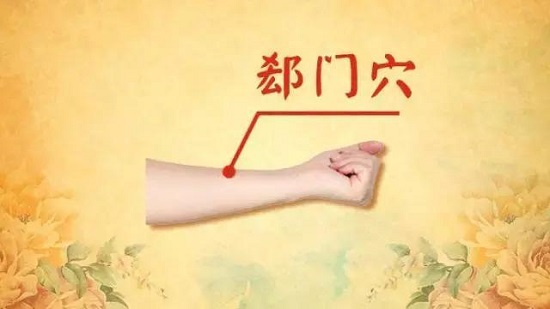
How to locate the Ximen acupoint? The Ximen acupoint is situated along the line connecting the Quze and Daling acupoints on the inner side of the forearm. To find it specifically, place your left hand horizontally across the wrist crease of your right hand, measure with four fingers plus one more finger, and the midpoint of the right forearm is the Ximen acupoint. This method pertains to massage, which, unlike acupuncture, does not require extreme precision. Given the width of a finger, the acupoint can certainly be pressed accurately. Even if it’s not pressed precisely, there’s no need to worry. As the saying goes in Traditional Chinese Medicine acupuncture: “Even if the acupoint is missed, staying along the meridian ensures effectiveness.”
The character "郄" means pore or opening, while "门" signifies a gateway for passage. In traditional Chinese medicine, the name of the Ximen acupoint refers to the fact that the meridian water energy of the pericardium channel flows back into the body through this node. The energy substance at this acupoint is the warm meridian water transmitted from the Quze acupoint, which, upon reaching this point, returns to the internal meridian of the pericardium channel through the earth-level pores of this acupoint, hence the name Ximen.
The efficacy of massaging the Ximen acupoint includes treating angina pectoris, palpitations, myocarditis, hematemesis, chest and hypochondriac pain, cough, pleurisy, mastitis, forearm pain, axillary swelling, epilepsy, mania, furuncles, stomach pain, and other conditions.
Massage method: Press the Ximen acupoint with the pad of your thumb for about 5–6 minutes each time, applying some force—that is, the pressure should be relatively strong. Perform twice daily, and you can massage both sides.
Do you understand?

Friends with heart disease and those preventing angina, I'm telling you, consistency is key!
If you find this article helpful after reading it, please follow and offer your valuable suggestions to encourage the author to publish more good articles.
"Traditional Chinese Medicine Old Hu" original. Please credit the source for any reprints or copies.
A single move of your finger can save a person and also promote the treasures of the Chinese nation.