Master 5 Variations of Si Jun Zi Tang, and You Can Effortlessly Address 99% of Spleen Deficiency Cases
Among the traditional Chinese medicine formulas for regulating spleen-stomach qi deficiency, Si Jun Zi Tang is indeed a renowned "big brother," considered the premier formula for fortifying the spleen and supplementing qi. However, it's like a basic template; when used alone, its effects can sometimes be less pronounced. But the remarkable aspect of our traditional Chinese medicine lies in its ability to adapt. By making simple additions and subtractions to the formula, we can make it exert different therapeutic effects, easily addressing various spleen deficiency problems.
Let's first talk about Yi Gong San, which is Si Jun Zi Tang plus the single herb Chen Pi (dried tangerine peel). Chen Pi is an expert in regulating qi in traditional Chinese medicine. When a person has spleen deficiency combined with qi stagnation, symptoms like poor appetite and abdominal distension can occur, and the bloating is often more severe than in typical spleen deficiency cases. In such situations, adding Chen Pi to Si Jun Zi Tang is like adding a "booster" to the formula. It enhances the effects of regulating qi and harmonizing the stomach, allowing the qi dynamics of the spleen and stomach to flow more smoothly, naturally alleviating these symptoms.
If spleen deficiency is combined with dampness pathogens, then Sijunzi Decoction plus Chenpi and Banxia becomes Liujunzi Decoction. Banxia is a powerful herb in Traditional Chinese Medicine for drying dampness and resolving phlegm, and together with Chenpi, it significantly enhances the ability to warm and transform dampness and phlegm. For patients who experience excessive phlegm in the throat, heavy limbs, dizziness, fatigue, and persistent sleepiness, the condition is often due to spleen deficiency combined with dampness pathogens. Liujunzi Decoction can effectively address this by transforming the internal dampness pathogens and restoring the normal function of the spleen and stomach.
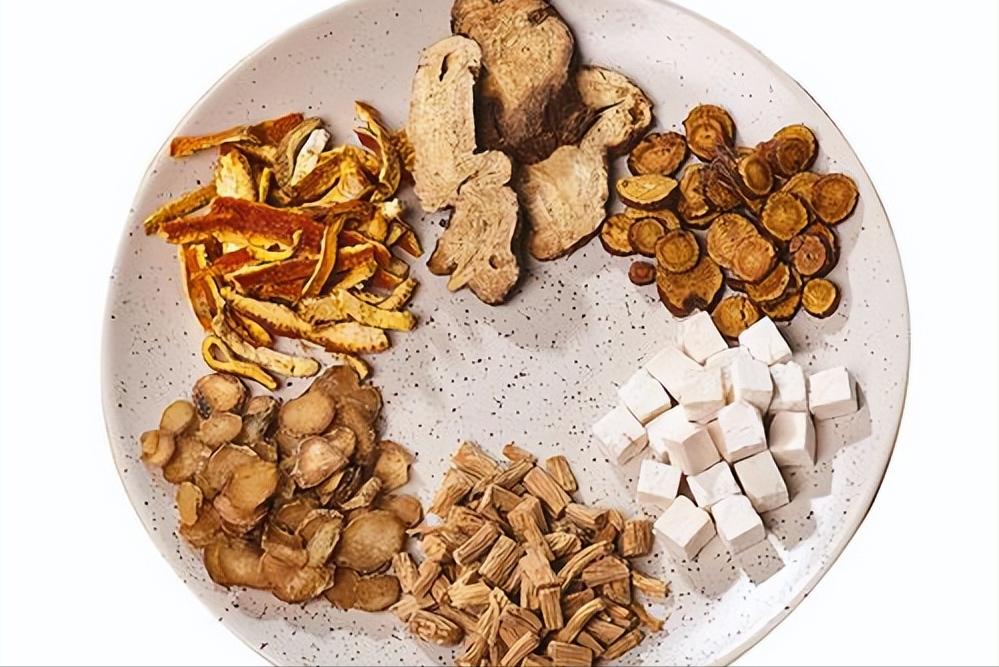
Another scenario is when there is cold in the stomach, dull pain, loose stools, and frequent belching or acid reflux. In such cases, adding Chenpi, Banxia, Sharen, and Muxiang to Sijunzi Decoction forms Xiangsha Liujunzi Decoction. Sharen warms the middle to dispel cold and promotes qi flow to regulate the middle, while Muxiang promotes qi circulation to relieve pain, strengthens the spleen, and aids digestion. The combination of these herbs significantly enhances the ability of Xiangsha Liujunzi Decoction to regulate qi and dispel cold, specifically targeting conditions where cold pathogens stagnate in the stomach and qi flow is obstructed.
If overeating or dietary indiscipline leads to severe food stagnation symptoms such as bitter taste in the mouth, bad breath, constipation, and acid reflux, Sijunzi Decoction can also be adapted. Adding Huangqi, Biandou, and Huoxiang turns it into Liushen Powder. Huangqi tonifies qi and raises yang, Biandou strengthens the spleen and transforms dampness, and Huoxiang transforms dampness, harmonizes the middle, relieves summer heat, and promotes outward release. When combined with Sijunzi Decoction, these three herbs help the spleen and stomach digest the stagnant food and restore their transportation and transformation functions.
Another variation involves removing Fuling from Sijunzi Decoction and adding Ganjiang to form Lizhong Decoction. This is a renowned formula for treating spleen and stomach deficiency-cold. Individuals with spleen and stomach deficiency-cold often experience poor appetite, a cold sensation in the lower abdomen, and diarrhea after consuming cold foods. Ganjiang in Lizhong Decoction warms the middle to dispel cold and, together with the other herbs, tonifies the spleen and stomach's yang qi, warming them up and naturally alleviating the symptoms.
Look, with different variations of the Si Jun Zi Tang, it can cover 99% of spleen deficiency cases. Moreover, traditional Chinese medicine has more than just these methods for regulating spleen deficiency. We can also combine Si Jun Zi Tang with other formulas for targeted treatment. For example, the classic Si Jun Zi Tang combined with Si Wu Tang forms Ba Zhen Tang, which nourishes both qi and blood. If qi and blood deficiency is severe, Ba Zhen Tang can be further enhanced by adding cinnamon and astragalus to become Shi Quan Da Bu Tang, warming and tonifying the body's qi, blood, yin, and yang.
Therefore, Si Jun Zi Decoction is like a "master of versatility," which, under the skillful application of Traditional Chinese Medicine, can safeguard our spleen and stomach health.