"Six-Sound Nourishing the Organs" formula, practice morning and evening to nourish the viscera and strengthen the body
In China's traditional health-cultivation culture, there is a simple and effective practice—the "Six-Sound Formula." Through six specific vocalizations (xu, he, hu, xi, chui, xi), combined with breathing and movements, it helps people regulate internal organ function, balance qi and blood, and relieve stress.
The theoretical basis of the Six-Sound Formula is closely linked to TCM's Five Elements theory and zang-fu organ theory. TCM holds that the body's five viscera (liver, heart, spleen, lung, kidney) and six fu organs correspond to the five elements of nature (wood, fire, earth, metal, water), and the six sounds of the formula correspond to different zang-fu. For example, "xu" corresponds to the liver, "he" to the heart, "hu" to the spleen, "xi" to the lung, "chui" to the kidney, and "xi" to the sanjiao. By practicing these vocalizations along with the corresponding movements, one can regulate the functions of the related organs, promote smoother circulation of qi and blood, and achieve the health state of "yin balanced and yang secret."
Preparatory standing posture
To practice the Six-Syllable Formula, first adopt the preparatory posture. Find a place with fresh air that is quiet and comfortable. Stand naturally, feet shoulder-width apart, knees slightly bent, like a pine tree firmly rooted to the ground, gaze directed slightly downward and forward. Then close your eyes and breathe slowly and naturally, inhaling through the nose and exhaling through the mouth, allowing your body and mind to relax gradually. Let go of all distracting thoughts, focus your intention on the dantian, and commit your whole body and mind to the practice.
Key points of the Six-Syllable Formula movements
Soothing the liver and relieving depression — the "Xu" syllable technique
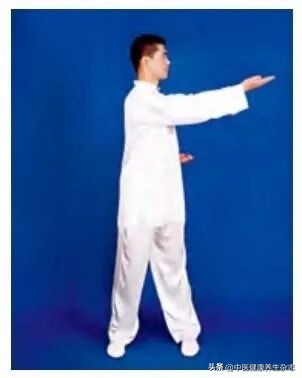
The liver governs dispersion and is responsible for regulating the smooth flow of qi in the body. When practicing the "xu" (shushing) technique, slow vocalization and bodily stretching can help disperse liver qi and relieve issues of liver qi stagnation (body movements see Fig. 1).
Movement essentials:
(1) Place both hands at the waist, rotate the waist to the left, extend the right hand forward, and exhale while producing the "xu" sound;
(2) Slowly withdraw the right hand back to the waist and inhale;
(3) Rotate the waist to the right, extend the left hand forward, and exhale while making the "shh" sound;
(4) Slowly bring the left hand back to the waist and inhale;
(5) Repeat in this manner, pronouncing the "shh" sound 6 times per set.
Nourish the heart and calm the mind — the "ha" sound technique
Modern life moves quickly, and many people are in a long-term state of tension and anxiety, which easily leads to palpitations, insomnia, and other problems. The "He" (exhale) mnemonic corresponds to the heart; the heart is the body's "sovereign organ" and governs the mind/spirit. When practicing the "He" mnemonic, producing a deep, resonant sound in coordination with an upward lifting motion of the body can relax the mind and promote the circulation of qi and blood to the heart (see body movement in Figure 2).
(1) With both palms held outward in front of the abdomen, squat, rotate the palms to face upward and cup them, rise up, and bring the cupped palms to the front of the chest;
(2) With both palms in front of the chest, the backs of the palms facing each other, fingers pointing downward;
(3) Slowly slide both palms down to in front of the navel while exhaling and making the “heh” sound;
(4) Push both palms outward, squat, turn the palms upward and cup them, stand up, and hold them to the chest;
(5) Repeat this, chanting the “heh” sound 6 times as one set.

Tonify the spleen and harmonize the stomach — the "Hu" syllable technique
If you often have indigestion, abdominal bloating or diarrhea, or feel physically weak and listless, it may be spleen deficiency. The "hu" sound exercise corresponds to the spleen. The spleen is the body's "postnatal foundation" and is responsible for transforming and transporting the quintessence of food and drink. When practicing the "hu" sound exercise, steady vocalization and contraction and relaxation of the abdomen can strengthen spleen and stomach function and promote digestion and absorption (body movements shown in Fig. 3).
(1) Place both hands about 10 cm in front of the lower abdomen, palms facing inward;
(2) Extend both hands forward and outward in a circular shape, squat, exhale and vocalize the sound "hu";
(3) Withdraw both hands back to the front of the lower abdomen, stand up, inhale;
(4) Repeat in this way, chanting the syllable “hu” 6 times as one set.

Moisten the lungs and stop coughing — the “xi” syllable technique
In autumn and winter, the weather is dry and many people are prone to lung problems such as coughing and wheezing. The “xi” syllable technique corresponds to the lungs; the lungs are the body's “canopy,” governing qi and respiration. When practicing the “xi” syllable technique, phonation should be even and coordinated with a forward-leaning body movement to regulate lung function and promote smooth breathing (body movements shown in Fig. 4).
(1) Raise both hands up to the chest, then lower the elbows to press the ribs, expand the shoulders and broaden the chest, tuck the head and retract the neck;
(2) Push both hands forward and squat, exhale while producing the “xi” sound;
(3) Externally rotate both hands with palms facing inward, withdraw both hands back to about 10 cm in front of the chest, rise, and inhale;
(4) Repeat this sequence, vocalizing the syllable “xi” six times per set.
Tonify the Kidneys and Secure Essence — The "Blow" Technique
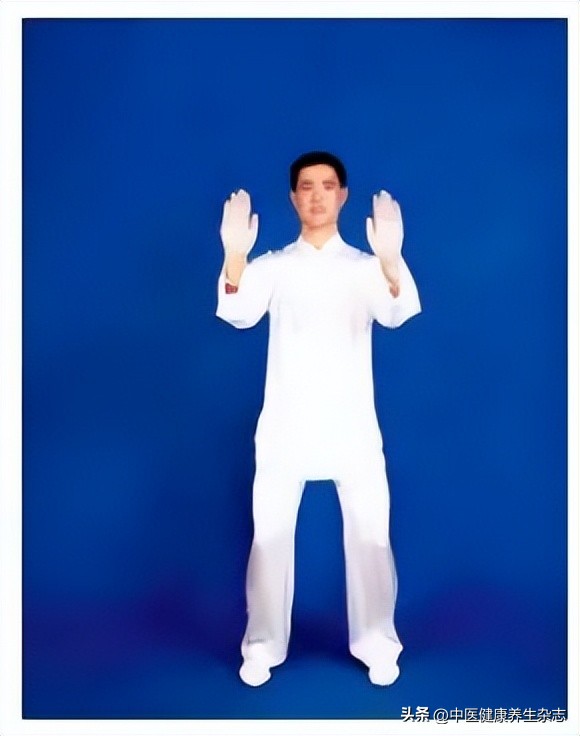
With increasing age, many people develop symptoms of kidney deficiency such as soreness and weakness in the lower back and knees, tinnitus, and dizziness. The "blow" technique corresponds to the kidneys; the kidneys are the body's "root of congenital constitution," governing the storage of essence and the metabolism of body fluids. When practicing the "blow" technique, short voiced exhalations combined with a squatting motion can strengthen kidney function and promote internal metabolism (body movements see Fig. 5).
(1) Move both hands from the abdomen backward, lightly placing them on the lower back;
(2) Slide both palms downward along the lumbosacral area and beneath the thighs, then extend them forward to encircle the front of the abdomen, squat, and at the same time exhale producing the "blow" sound;
(3) Draw both palms back to the abdomen and, inhaling as you rise, rub along the belt meridian posteriorly to the lower back;
(4) Repeat in this way, chanting the syllable “chui” six times per set.

Harmonize the triple burner — the “xi” syllable technique
The triple burner is the body's channel for fluid metabolism, divided into upper, middle, and lower burners. If the triple burner is not unobstructed, symptoms of systemic discomfort may occur, such as chest tightness and shortness of breath, abdominal bloating, constipation, etc. The "xi" sound technique corresponds to the triple burner; through cheerful vocalization and body-relaxing movements, it can harmonize the body's qi mechanism and promote the smooth flow of qi and blood (body movements see Fig. 6).
(1) Let both hands hang down, backs of the hands facing each other in front of the abdomen; lift the elbows and raise the body.
(2) Raise both hands above the head, separate them to the left and right, palms facing inward;
(3) Bring both hands back to the chest, fingertips facing each other, palms facing downward, press both palms downward, squat, exhale and make the sound “xi”;
(4) Let both hands hang down, backs of the hands facing each other in front of the abdomen, lift the elbows and raise up;
(5) Repeat in this manner, chanting the syllable “xi” 6 times as one set.

Key points for the finishing movement
Place both hands overlapping on the lower abdomen, then gently rub the abdomen three times clockwise and three times counterclockwise in turn; release the hands, return the body to its original position, and withdraw the left leg. At the same time resume normal breathing and draw attention away from the breath and movements.
For beginners, each posture can first be performed 3–6 times; as proficiency and fitness increase, gradually raise this to 6–9 times. Practice time can be arranged according to individual circumstances, and it is generally recommended to practice in the morning or evening when the air is fresh. It should be noted that one should not eat immediately before or after practice; it is best to practice about 1 hour after a meal to avoid affecting digestion.