Child “doesn't stand properly”? It's not just misbehavior — watch for this disease's key signs
The most common forms of scoliosis are the spine bending into a "C" or "S" shape. This is not simply an issue of "poor posture" — abnormal posture can lead to low self-esteem, anxiety, and social phobia in adolescents; severe cases may develop depression, directly affecting friendships and development, and can even impact other viscera and organs. Therefore, parents should cultivate a "discerning eye" to help children recognize the early signs of scoliosis.
Scoliosis manifests in four aspects
Be alert to whether a child "stands properly"
"Doesn't sit properly, doesn't stand properly" is a common remark parents make when educating their children. In fact, this may be a manifestation of scoliosis. The most direct effect of scoliosis on the body is disruption of its symmetry and balance. A C-shaped or S-shaped curved spine is accompanied by deformation and rotation of the vertebral bodies, often causing rib rotation and thoracic asymmetry. This curvature can lead to a series of postural abnormalities, commonly including uneven shoulders, a prominence on one side of the back (the "rib hump"), and even unequal pelvic height and trunk tilt.
Breathing difficulties, indigestion, or issues related to the spine
In severe adolescent idiopathic scoliosis, vertebral rotation is often present and marked thoracic distortion can occur. This twisting is like the body being wrung, placing a "shackle" on the heart and lungs by compressing the space for lung expansion and crowding the heart. Over time this can impair pulmonary function and increase the risk of cardiac insufficiency.
Rotation of the spine and deformation of the thorax affect not only cardiopulmonary function but also the digestive system. A deformed thorax may alter esophageal tension and compress the gastrointestinal tract, leading to impaired gastrointestinal motility and causing symptoms such as indigestion, loss of appetite, and constipation. In severe cases, the stomach may even become displaced, thereby increasing the risk of reflux esophagitis.
Always saying they’re tired from studying does not mean the child is lazy
After prolonged sitting and studying, children with scoliosis may feel fatigued and have difficulty concentrating due to spinal deviation and muscle imbalance, which in turn affects learning efficiency. After physical activities, especially those with large ranges of motion such as running and jumping, these children are prone to back pain.
Therefore, poor academic performance and reluctance to move may not be the child’s subjective choice. Although scientific exercise can help improve scoliosis, pain induced by activity will still greatly reduce the child’s willingness and ability to participate in physical education.
Do not diagnose "scoliosis" based on pain
Adolescents’ rapid growth period is a high-risk time for progression of spinal scoliosis. At the same time, this period also commonly features "growing pains." Only by accurately distinguishing "growing pains" from pain caused by spinal scoliosis can diagnosis and treatment of scoliosis avoid delay. "Growing pain" mainly presents as symmetric aching of both legs, often occurring in the afternoon or at night; it is a benign pain relieved by rest and does not require excessive evaluation. Pain from spinal scoliosis is concentrated at the apex of the most curved segment of the spine, is asymmetrically distributed, may not appear until adulthood (after skeletal growth has stopped), and the severity of pain does not correlate directly with the severity of the scoliosis.
How to determine whether the spine is "curved"?
Some children with spinal scoliosis may be asymptomatic. Therefore, "no pain does not mean no scoliosis." Visible abnormalities are the most critical sign of scoliosis in children. Parents can perform a preliminary assessment using the following observation methods.
Postural observation
Have the child remove their shirt, stand with their back facing you, and observe whether the shoulders, bilateral scapulae, and bilateral lumbar dimples are symmetrical and whether the spinal midline is straight; then have the child stand with feet together, knees extended, bend the upper body forward slowly to 90°, let the arms hang naturally, and observe the back from directly behind to see if there is an obvious prominence on one side of the thoracolumbar region.
Clothing observation
Observe whether the child’s collar is consistently tilted to one side, the hem of the clothing is uneven on both sides, the waistband is markedly oblique, or the pant legs are of unequal length.
If scoliosis is suspected, take the child to orthopedics promptly for professional evaluation by an orthopedic physician and, as indicated, imaging studies.
Full-spine X‑ray
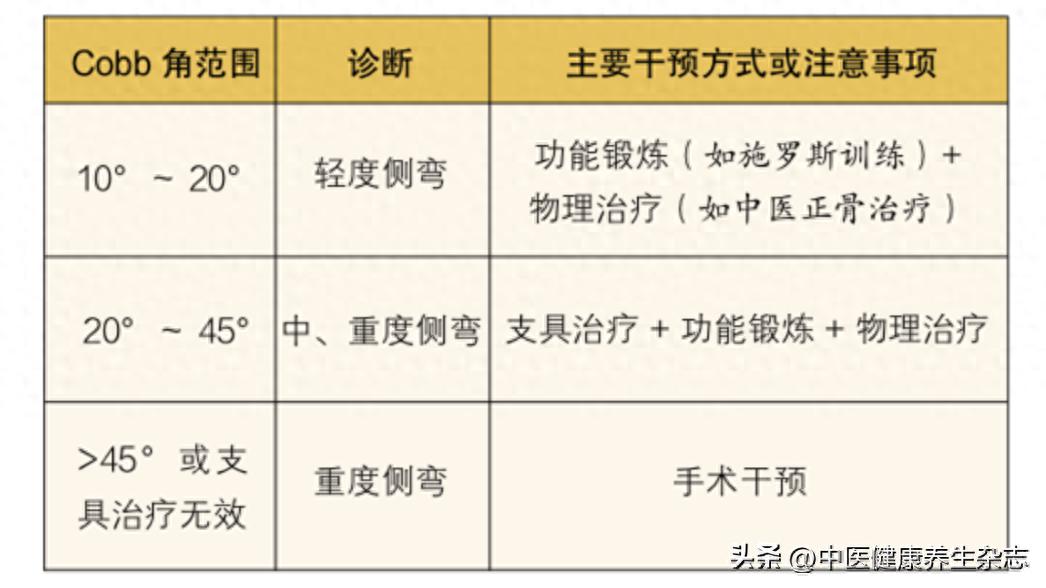
Can clearly display the entire spine and accurately measure the key parameter—the Cobb angle; it has low radiation dose, low cost, and is convenient for regular follow-up to monitor disease progression.
CT scan
Can produce a 3D image of the spine; through three-dimensional imaging, the complex spinal deformity can be observed as a whole, but the radiation dose is higher than that of X‑ray films.