I use these four back Shu points as the foundational formula for treating internal injury and miscellaneous diseases
Introduction: The four back Shu points focus on harmonizing qi and blood, and through flexible combinations, they are widely applied in clinical practice.
Clinical application of the "four back Shu points"
Tian Conghuo
The "Four Back Shu Points" refer to the four sets of back Shu points: Geshu (BL17), Ganshu (BL18), Pishu (BL20), and Shenshu (BL23). The author often uses these four points as the main focus, combined with a small number of other points, to treat internal injuries and miscellaneous diseases, often achieving ideal therapeutic results. Here, I would like to share and discuss this approach with fellow practitioners.
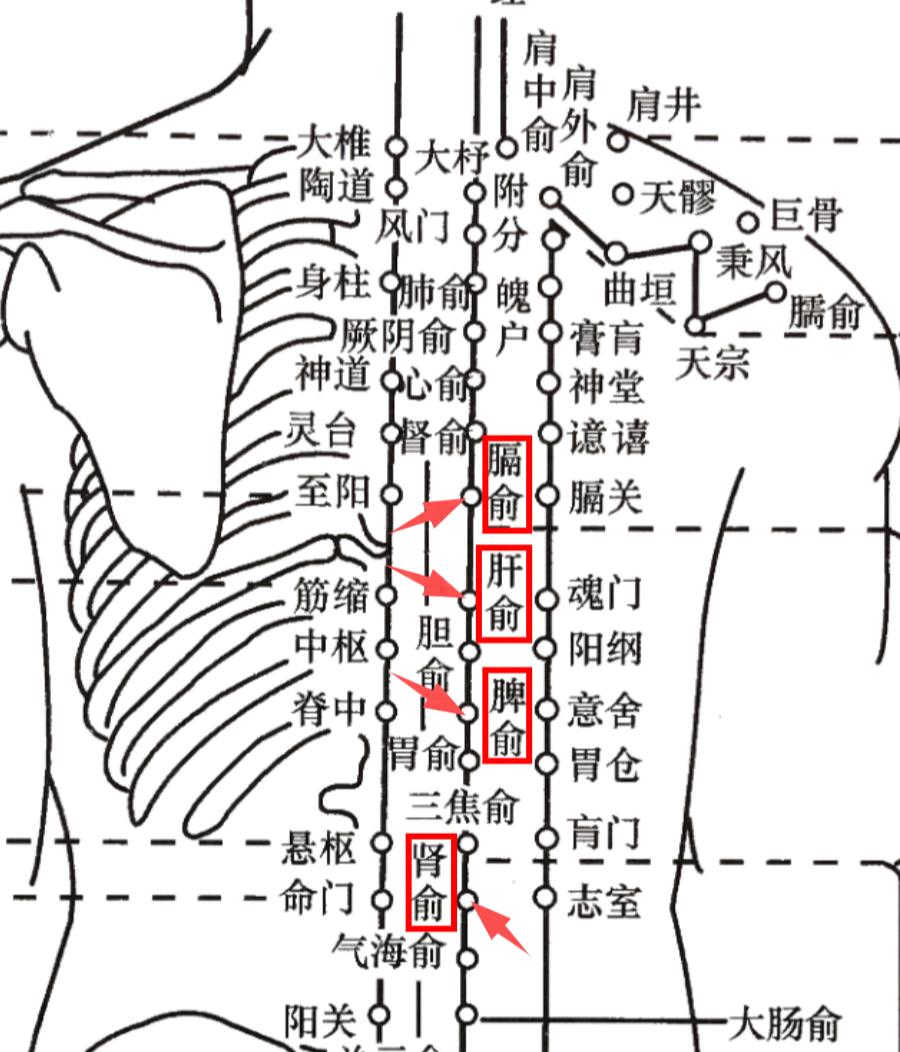
I. The Four Back Shu Points Focus on Regulating Qi and Blood
Back Shu points are specific points on the back where the qi of the internal organs and meridians is infused. The "Classic of Categories" records: "The five zang organs reside in the abdomen, and their meridian qi all emerges from the back along the Foot Taiyang meridian, which are the Shu points of the five zang organs." Each of the five zang organs has its own Shu point, but in this prescription, only the Shu points of the liver, spleen, and kidney are selected, along with Geshu (BL17), the influential point of blood. The principle of this prescription is to regulate qi and blood.
Qi and blood are the fundamental material basis and physiological functions of the human body. When qi and blood are harmonized, the five zang and six fu organs can perform their normal physiological functions. The ascending, descending, floating, and sinking of qi rely on the normal free flow of the liver. Therefore, in the prescription, Ganshu (BL 18) is selected to soothe the liver and regulate qi, and it works together with Geshu (BL 17), the influential point for blood, to harmonize qi and blood. The harmonization of qi and blood must be based on their abundance, and the production of qi and blood depends on the normal transportation and transformation of spleen qi. Hence, Pishu (BL 20) is included in the prescription to strengthen the spleen and stomach, promoting the generation of qi and blood. The transportation and transformation of spleen qi require the promotion of original qi, that is, the warming and steaming of kidney yang and the nourishing and moistening of kidney yin. Therefore, Shenshu (BL 23) is added to assist its function, thereby regulating and tonifying the acquired foundation while consolidating the innate root.
The four acupoints together function to harmonize qi and blood, warm and strengthen the spleen and kidneys.
2. Flexible Combination, One Formula with Multiple Applications
In clinical practice, the author uses this prescription both alone and in combination with other acupoints. The selection of accompanying points is often flexible, depending on the specific condition.
When treating neuropsychiatric disorders such as insomnia, neurosis, and schizophrenia, it is often paired with Xinshu (BL15) and Dazhui (GV14). For cough and asthma, it is commonly combined with Feishu (BL13), Fengmen (BL12), and Dazhui (GV14). For gastrointestinal diseases, it is paired with Zhongwan (CV12), Liangmen (ST21), Zusanli (ST36), and other acupoints that harmonize the spleen and stomach. For deafness and tinnitus, it is combined with Jiaosun (SJ20), Tinggong (SI19), and Yifeng (SJ17). For urticaria, it is used together with Baihui (GV20), Fengchi (GB20), and Qimen (LR14).
The broad applications of this formula are difficult to fully enumerate here, so only typical cases encountered during clinical practice will be reviewed with readers:
Case 1:
Ms. Shi, female, 38 years old, primary school teacher. Ten years ago, the patient developed episodic pain in both hands without an obvious cause, diagnosed as "Raynaud's syndrome" by multiple hospitals. Despite years of treatment with both Chinese and Western medicine, there was no improvement. Over the past three months, the condition has worsened. The pain in both hands is now triggered by exposure to cold air or cold water, presenting as severe, needle-like or knife-cut pain accompanied by swelling and ecchymosis.
The patient visited during the hottest days of summer, yet still required warm water for washing. I consider this syndrome to be a result of cold congealing the blood vessels, leading to stagnation of qi and blood. The treatment approach should be to warm the meridians, dispel cold, and harmonize qi and blood.
The "Four Back Shu Points" were needled to harmonize qi and blood, Dazhui (GV14) was moxibusted to warm and unblock yang qi and expel pathogenic cold, and ten-finger pricking bloodletting was performed to remove stasis and promote regeneration.
After the third consultation, the patient reported that the pain had diminished. After the sixth consultation, pain episodes had become infrequent.
Case Two:
Wang XX, female, 58 years old. Chief complaint: deafness and tinnitus for over 4 months. Four months ago, the patient was handling household chores before the Spring Festival and felt physically and mentally exhausted. One morning, she suddenly experienced a blocked sensation in her right ear, unable to hear any sounds, accompanied by dizziness and tinnitus. After undergoing audiometry at Beijing People's Hospital, she was diagnosed with sensorineural deafness. Despite receiving extensive Western medication and hyperbaric oxygen therapy, her symptoms did not improve. She was referred for acupuncture treatment and received needling at the "Four Back Transport Points" combined with Jiaosun, Tinggong, and Yifeng.
After one treatment course (10 sessions per course), symptoms of dizziness and tinnitus decreased, and hearing improved. She was able to use the affected ear to answer phone calls. After two treatment courses, hearing in both ears became nearly equal. A repeat audiometry was recommended, but the patient declined as her hearing had already returned to normal.
Sensorineural deafness is widely recognized as a challenging condition to treat clinically. Achieving near-complete recovery after just over 20 acupuncture sessions is remarkable.
III. Different conditions require different methods of treatment.
Diseases have cold and heat, deficiency and excess, and the methods include warming, cooling, tonifying, and purging. The "Four Back Shu Points" alone as a set of acupoints cannot fulfill the purpose of tonifying deficiency or purging excess. The author often applies additional methods on these points, such as adding pricking and bloodletting for excess, heat, and stasis conditions; warming moxibustion for deficiency and cold conditions; and cupping for wind and phlegm conditions. For instance, the author successfully treated a case of addiction to sleeping pills:
Case 3:
Zhang XX, male, 62 years old, from Handan, Hebei. The patient developed insomnia 30 years ago due to psychological stimulation. After multiple treatments proved ineffective, the patient reluctantly began taking sleeping pills. Over the past 30 years, the dosage gradually increased. Prior to seeking treatment, the patient was taking over 20 tablets of diazepam daily, along with 300–350 grams of white liquor, to fall asleep. Each night, he only slept for about 2–3 hours. During the day, he needed to drink strong tea to stay alert and had to consume large amounts of spicy food with every meal to have an appetite. At the time of consultation, the patient presented with a flushed red complexion, loud speech, heavy breathing, irritability, a red tongue with a yellow coating, and a wiry and slippery pulse.
Long-term addiction to alcohol and medication led to their toxic effects entering the bloodstream, causing Qi and blood stasis. Over time, the stagnation generated heat, which disturbed the heart-mind. The treatment should focus on draining the toxic heat and regulating Qi and blood.
First, the "Four Back Transport Points" plus Dazhui (GV14) were needled. After needle removal, bloodletting was performed via pricking at various points. Due to the severity of the toxic heat, each treatment session was supplemented with bloodletting.
After one week of treatment using the above method, the alcohol addiction was broken. Two weeks later, the patient began reducing the use of sleeping pills. After 20 sessions, the medication was reduced to 4 tablets per day, and both alcohol and tea were completely discontinued.
This case is a typical example of excess syndrome and heat syndrome. Acupuncture alone on the "Four Back-Shu Points" is insufficient to achieve the goal of clearing heat and purging excess. Therefore, bloodletting therapy was additionally employed to purge heat and remove stasis, thereby achieving the aim of harmonizing qi and blood.
Fourth, emphasize technique, frequently use oblique needling
When needling the "Four Back-Shu Points," whether the patient is in a sitting or prone position, the needling sequence is always from top to bottom and left before right. Emphasis is placed on locating the needling sensation, seeking the arrival of qi at the affected area, and then applying comprehensive techniques such as lifting-thrusting and twisting according to the principle of tonifying deficiency and reducing excess. Attention is also given to controlling the intensity of stimulation: for tonification, a gentle stimulation technique should be used; for reduction, a heavy stimulation technique should be applied. If there are no obvious signs of cold, heat, deficiency, or excess, a neutral tonifying-reducing method with moderate stimulation is generally employed.
The needle retention time is typically around 30 minutes. For some recurrent conditions, such as epilepsy or asthma, needle retention may sometimes be required for up to one hour.
Another noteworthy phenomenon is the direction of needling. When needling the back-shu points (except for those in the lumbosacral region), oblique or horizontal needling is performed from below upward. This direction is not intended for the reinforcement-reduction technique of "meeting or following" but rather follows the admonition from the "Great Compendium of Acupuncture and Moxibustion": "The abdomen is as deep as a well; the back is as thin as a pancake." It is also a practical method to facilitate covering the patient with clothing or bedding after needling and to avoid injuring the internal organs.
Conclusion:
Although the "Four Back-Shu Points" represent a specific acupuncture prescription, they actually embody a method for treating internal injuries and miscellaneous diseases. The "Inner Canon: Regulating the Channels" states, "When qi and blood are not in harmony, a hundred diseases arise and transform." Therefore, harmonizing qi and blood is the key to treating diseases.
However, the methods for harmonizing qi and blood vary greatly depending on syndrome differentiation point selection and manipulation techniques. The author's use of "Geshu (BL17), Pishu (BL20), Ganshu (BL18), and Shenshu (BL23)" (collectively referred to as the "Four Back-Shu Points") as a point combination for harmonizing qi and blood is based on nearly 50 years of repeated validation and accumulated experience. Through extensive clinical observation, we have confirmed that many common and difficult-to-treat diseases, when addressed with syndrome differentiation and treatment primarily focusing on the "Four Back-Shu Points," yield unexpectedly effective results. Clinical records are continuously maintained for future in-depth research.