Encountering a Patient with Severe Nosebleed, "Pressing and Kneading" One Acupoint to Stop Epistaxis, Achieving Rapid Results
Introduction: The author discovered an acupoint for stopping nosebleeds—Tianliang acupoint. Everyone can give it a try.
Massage the "Tianliang" Acupoint to Stop Epistaxis
Han Heming
Epistaxis: Patients may experience it due to lung heat or wind-heat; stomach heat; liver yang hyperactivity; or kidney water deficiency leading to rising liver fire, which forces blood to flow recklessly and exit through the nose.
If epistaxis occurs during an externally contracted febrile disease, it is referred to as "red sweat." This indicates that the pathogenic factor is seeking an outlet, often resolving along with the bleeding, signaling a favorable turn in the course of the illness. However, general epistaxis is caused by blood heat or overstrain damaging the yang collaterals. Ultimately, it involves blood loss and yin deficiency, so it must be stopped.
In recent years, when encountering patients with general epistaxis in outpatient clinics, street markets, or rural fields, the author has promptly applied voluntary "massage" therapy to stop the bleeding before inquiring about the condition, achieving rapid results.
Basis for selecting acupoints
"Sudden excessive eating and drinking lead to intestinal fullness; irregular daily routines and excessive exertion cause damage to the collaterals. Damage to the yang collaterals results in external bleeding, and external bleeding leads to epistaxis." "Knowing that liver disease can affect the spleen, one should first strengthen the spleen."
—"Lingshu·Baibing Shisheng Pian" (The Spiritual Pivot: The Origin of All Diseases)
"The yang collaterals are the ascending network of vessels."
— Zhang Zhicong
From this, it is understood that the pathological location of the yang collaterals is primarily in the upper and superficial regions; therefore, for "nosebleeds," external treatment such as "massage" can be directly applied to the body surface to trace the clues.
"The bladder meridian of foot-taiyang originates from the inner canthus, ascends to the forehead, and meets at the vertex. Its branch runs from the vertex to the upper corner of the ear. Its straight branch enters and connects with the brain, then emerges and descends along the nape of the neck."
"The bladder is associated with the Foot-Taiyang channel. ...It governs diseases related to tendons, including hemorrhoids, malaria, mania, epilepsy, pain in the head, forehead, and nape, yellowing of the eyes, tearing, and epistaxis."
—"Lingshu · Jingmai Pian" (The Spiritual Pivot · Chapter on Channels and Vessels)
The condition of rhinorrhea is characterized by clear nasal discharge and nasal congestion, which belongs to the Taiyang wind-cold syndrome. Therefore, the author initially experimented with applying pressure to the "Tianliang" point on the Foot-Taiyang channel to treat rhinorrhea and found that nasal congestion was temporarily relieved, surpassing the effect of needling the "Yingxiang" point. Consequently, the treatment was promptly applied to epistaxis, and the nosebleed stopped immediately upon application.
Case Example
Patient Cao Asi, male, 46 years old, from Huinan Commune, Nanhui County.
He worked as a pottery repairer. At 16:50 on March 21, 1963, he took the Hangtou bus home from Nanqiao Town, Fengxian County; during the ride, he experienced a nosebleed. He stuffed paper into his nostrils, but the blood flowed out from his mouth. The author, sitting beside him, immediately applied pressure to the "Tianliang" acupoint for about one minute without asking about his condition, and instructed him to remove the stuffing. The nosebleed stopped immediately. All the passengers who witnessed this were amazed!
The patient nodded in gratitude, gave his name, and exposed his abdomen, saying:
"My upper abdomen has been distended for three years, and repeated treatments have been ineffective. I usually have a strong appetite and feel hungry easily, but otherwise, I have no discomfort and my spirits are quite good. Today, I had three nosebleeds in Nanqiao Town; now, with the vibration of the bus, the nosebleed started again and wouldn't stop." Based on the preliminary impression from the chief complaint, it can be inferred that "stomach heat is inherently excessive, and blood heat has damaged the collaterals."
Massage Area
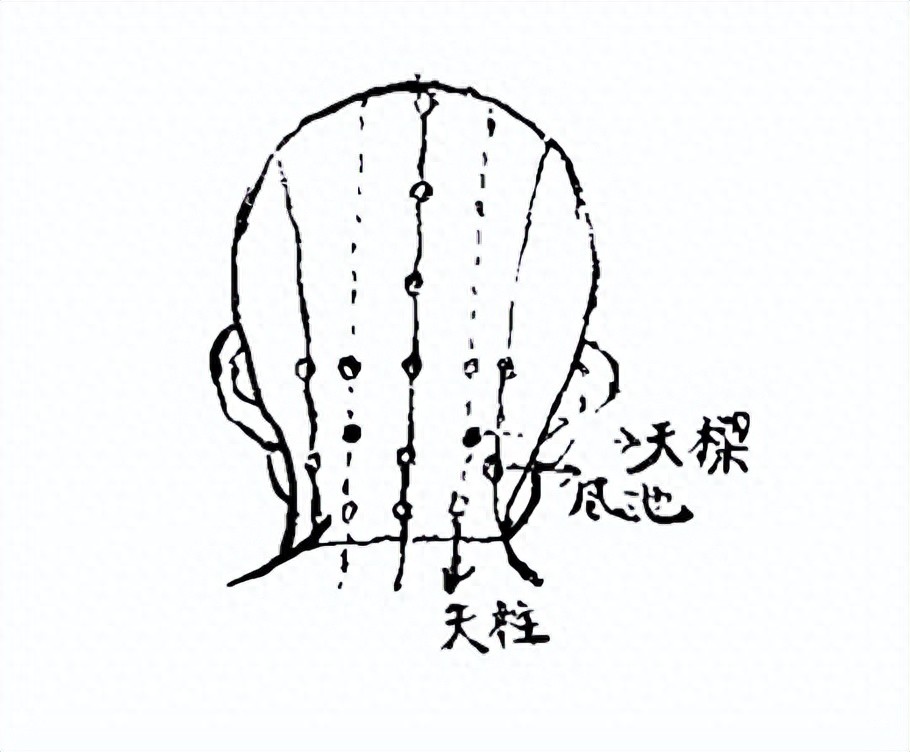
The acupuncture point named "Tianliang" was designated by the author. This point is located on both sides of the posterior neck along the pathway of the Foot Taiyang Meridian, approximately diagonally above the "Fengchi" point and directly above the "Tianzhu" point on the same meridian, on the outer edge of the large tendon; it lies in a depression close to the posterior edge of the neck bone. When the "Tianliang" point is located and pressure is applied using the "pressing technique," a distinct sensation of soreness, heaviness, and distension is felt, extending to the nasal cavity.
Procedure
During the procedure, the patient may be standing, sitting, or lying on their side.
The practitioner supports the patient's forehead with the left hand (or right hand), while using the thumb and index finger of the right hand (or left hand) (fingers pointing upward) to press the "Tianliang" acupoints on both sides of the patient. Apply pressure gradually from light to moderate, for about one minute. Simultaneously, instruct the patient to remove any foreign objects in the nose to avoid damaging the nasal mucosa and causing bleeding. This can stop epistaxis.