The Acupoint That Makes People "Happy": Yanglingquan
In martial arts novels, there are sometimes plots describing a certain acupoint on the body. After being pressed by a master, the person bursts into uncontrollable laughter and cannot move normally. Of course, this is just a literary creation based on imagination. However, although our bodies do not have a "laughing acupoint," there is an acupoint that can make people feel cheerful and relaxed—it is the Yanglingquan acupoint.
The Acupoint That Makes People "Happy"—Yanglingquan
Origin of the Acupoint Name: In traditional Chinese medicine, the lateral side of the knee is considered yang, and the head of the fibula resembles a hill. The depression anterior and inferior to this "hill" is where the meridian qi flows like water into a deep valley or mountain spring, hence the name Yanglingquan (Yang Mound Spring).
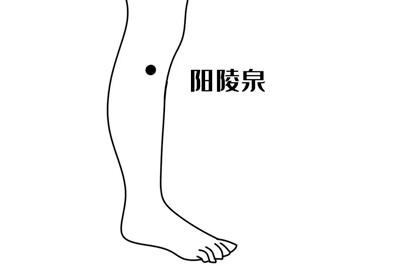
Key Points for Locating the Acupoint: Located slightly anterior to the depression at the head of the fibula on the lateral side of the lower leg, below and lateral to the knee.
When locating the acupoint, sit upright naturally so that the thigh and lower leg form a right angle. On the lateral side of the lower leg, just above the knee crease, you can visually observe or feel a prominent bony protrusion with your hand—this is the fibular head. Yanglingquan is located in the depression approximately three finger-widths anterior and inferior to this bony protrusion.
Yanglingquan is an acupoint on the Gallbladder Meridian of Foot-Shaoyang. What symptoms can arise from disharmony in the gallbladder meridian?
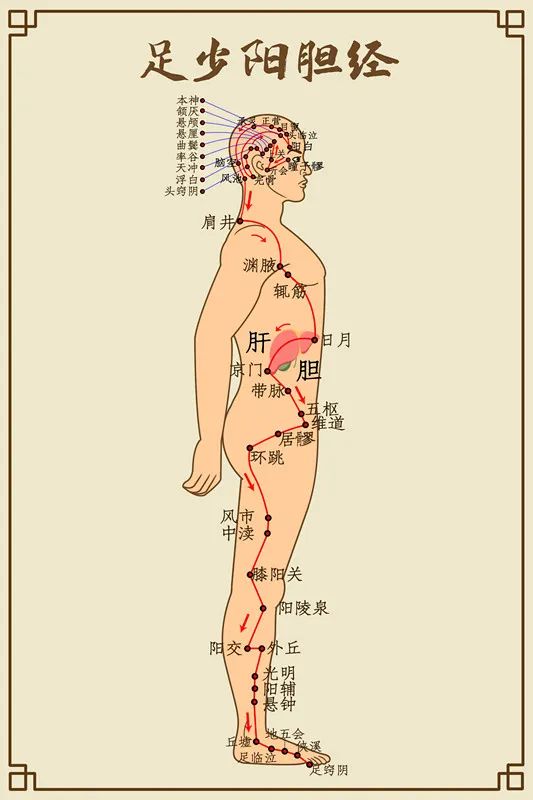
The Spiritual Pivot · Meridians" states: "The gallbladder meridian of foot-shaoyang... when disturbed, causes symptoms such as bitter taste in the mouth, frequent sighing, and pain in the heart and flanks that prevents turning over..." "Frequent sighing" refers to the tendency to sigh often, which is a manifestation of low spirits. The liver and gallbladder are internally and externally related, governing the free flow of qi and responsible for regulating emotions. Massaging the Yanglingquan (GB34) acupoint can regulate the gallbladder meridian, invigorate liver qi, and bring about a joyful mood. Therefore, ancient physicians described the Yanglingquan acupoint as the body's "happy point.
Massaging Yanglingquan
Method: When massaging the Yanglingquan acupoint, use the entire palm with force. First, locate the point with the thumb, placing the thumb on the Yanglingquan acupoint while the other four fingers press firmly against the calf. Apply pressure with the thumb pad and massage in a circular motion—first clockwise for 3 minutes, then counterclockwise for 3 minutes. Repeat on both legs. If you have moxa sticks at home, you can also apply moxibustion for 10 minutes, until the skin feels slightly warm.
Every morning after waking up, massage the Yanglingquan acupoint using the method described in this article for 6 minutes. This can help maintain a good mood throughout the day. The heart governs the storage of spirit, and a good mood can bring joy to one's "spiritual consciousness," thereby directly influencing the overall state of the body.
Special note: When massaging the Yanglingquan acupoint, it is essential to achieve the sensation of "de qi," which is a feeling of soreness, distension, or numbness.
Yanglingquan is also a key acupoint for treating gallbladder disorders.
Yanglingquan is the He-Sea point of the Gallbladder Meridian and the influential point for tendons. According to the *Yellow Emperor's Inner Classic*, "He-Sea points treat internal organs," "when pathogenic factors are in the organs, select the He-Sea points," and "for gallbladder disorders with alternating chills and fever, select Yanglingquan." Therefore, as a He-Sea point, Yanglingquan can also be used to treat liver and gallbladder diseases, as well as gallbladder disorders.
Yanglingquan has the functions of soothing the liver and gallbladder, clearing damp-heat, and relaxing tendons and joints. As stated in the *Yellow Emperor's Inner Classic*, "For gallbladder disorders, symptoms include frequent sighing, bitter taste in the mouth, vomiting of stagnant fluids, palpitations, fear of being captured, a sensation of obstruction in the throat, and frequent spitting. For these conditions, examine the Gallbladder Meridian from its origin to its end, and if there is a sunken pulse, apply moxibustion. For alternating chills and fever, select Yanglingquan." This acupoint is a key point for treating gallbladder disorders. Since the liver and gallbladder are internally and externally related, this point is highly effective in treating hypochondriac pain caused by qi stagnation, blood stasis, and liver-gallbladder disorders. The *Song of Acupoints for Miscellaneous Diseases* states: "For hypochondriac pain, simply use Yanglingquan."
For those experiencing severe colicky pain in the right upper abdomen due to cholecystitis or gallstones, if the hospital is far away and medication is temporarily unavailable, they can also use the acupressure method on Yanglingquan (GB34) to relieve the pain.
Taichong (LR3) + Yanglingquan (GB34) equals Xiaoyao Wan
Xiaoyao Wan is one of the medications used to treat liver depression and spleen deficiency. It has the effects of soothing the liver, strengthening the spleen, nourishing blood, and regulating menstruation. It shows significant efficacy in treating symptoms such as depression, chest and hypochondriac distension and pain, dizziness, and reduced appetite caused by liver qi stagnation. However, all medications have potential side effects, and Xiaoyao Wan should not be taken continuously for an extended period. Elderly individuals in need of soothing liver depression and relieving stagnation may consider massaging the Taichong (LR3) and Yanglingquan (GB34) acupoints, as the therapeutic effects are comparable to taking Xiaoyao Wan orally.
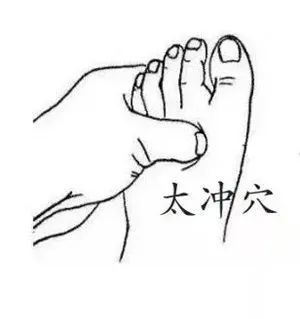
Taichong (LR3) is the source point of the Liver Meridian of Foot-Jueyin. Stimulating Taichong can soothe the liver, clear heat, and nourish the liver blood. When liver qi stagnation causes symptoms such as insomnia, headache, and distending pain in the chest and hypochondrium, massaging Taichong can help soothe the liver and nourish the blood. This point is located on the dorsum of the foot. To locate it, slide your finger upward along the web between the first and second toes toward the dorsum of the foot until you feel a depression—this is Taichong. For massage, press the point with your thumb and apply circular kneading for 1–2 minutes. This can be done 2–3 times daily.
The Yanglingquan (GB34) acupoint is the influential point of the gallbladder meridian of foot-shaoyang, where the meridian qi converges. Stimulating this point can help soothe the liver and promote gallbladder function, relax tendons and activate collaterals, relieve spasms and alleviate pain, as well as strengthen the waist and knees. It is effective in treating conditions such as lower back and leg pain, cholecystitis, knee arthritis, and sciatica. As we all know, "the liver and gallbladder are closely related." When the liver meridian is obstructed, the gallbladder meridian is naturally prone to issues. Based on massaging the Taichong (LR3) acupoint, combining it with the same technique to massage the Yanglingquan (GB34) acupoint can enhance the therapeutic effect.